Waiting For Eels


It is Halloween and the river is freezing. Cakes of ice are flowing. The ice shelf is growing out from the edge and getting thicker each day. The nights have been down in the teens and single digits and the mighty Yukon is slowing down for the winter.
The salmon are done running, but there are still whitefish and others in the river. But right now it’s time for the great eel migration. They enter the Yukon from the Bering Sea. After living their life attached to salmon, sucking the life blood out of them until they are fat enough to detach, they make their migration up river to spawn in the silty Yukon River.
Lamprey eels are a delicacy here on the Yukon. They are raked up from long narrow holes chopped in the ice, using a long board with sharp headless nails up and down the sides. The eel stick is raked through the water back and forth until an eel is impaled on the nails much like a hotdog on a stick. They wrap there slithering bodies around the stick and are raked up and out from under the water and thrown on top of the ice. They act and look very much like a snakes slithering around your feet until the cold overcomes them and they quickly freeze.

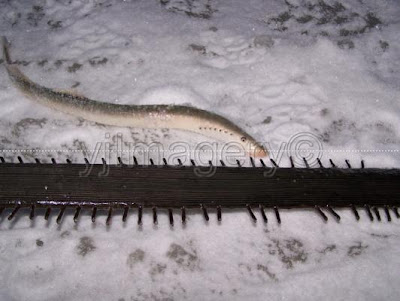
When they are running thick dip nets are used and great quantities can be harvested. We even have a commercial fishery here on the Yukon and we will get a $1 a pound for them at the local salmon buying office. There is a market for them in Asia and they are also an important food source here.
The first eels of the season are brought home and shared for everyone to get a taste of the rich oily flavor. They remind me of canned sardines and are very good baked or fried.
Some years we miss them and they pass, so we try to check the river daily starting before Halloween and into mid-November until they arrive. Each day someone from the village will chop a slot in the ice to see if they have arrived.
We are still waiting patiently ....this all hallows eve.

The Autumn Harvest


Making meat is one of the most important aspects of life here in rural Alaska. I would say it's right up there with getting our wood pile put up so we can have heat during the long Alaskan winter.

Meat can come in many forms. Folks here harvest waterfowl and ptarmigin, and even some caribou and seal. But it's moose that fills our freezers and is on the table more than most other dishes.

Moose is suprisingly very good, and very good for you. It's filled with vitimins and tastes great; nice and tender (and nice and fat depending on your timing of the harvest and the animal chosen for the freezer).

We don't hunt for horns here, so an average sized bull with modest antlers is desirable. We harvest before the rut, so the meat is tender and doesn't have a gamey taste, like a late season large bull would have.

The hunt itself is a peaceful, get in tune with nature, kind of thing. There is alot of waiting by the right patch of timber. Usualy there is swamp involved near by and we sit and watch the waterfowl, beaver, and other wildlife. We sit there until a moose steps out of the thick timber to graze or get a drink from the nearby swamp.

When a moose is finally down, we take great care to keep the meat clean and dry. We use tarps to lay our winters food on as we load it up in the boat. It is then brought home and hung in the smoke house to age, then cut up and packaged for the freezer by our own hands in the kitchen (no processing plants here).

The freezer is filled by late September fall. And we are lucky if we can find space in the freezer to stuff in a few more ducks. This will be our larder for the long winter months, supplimented with fresh fish from our under ice nets, and perhaps fresh caribou if they migrate close enough.

We can never count on the planes to be flying us in our store bought groceries. We are much like farmers that have crops and animals that need no tending, and have learned to be able to count on ourselves for our daily bread.

A Bounty Of Berries


As we go into late summer many of the wildflowers on the tundra turn into berries. All kinds of berries. They become so plentyful that you cannot take a step on the spongy moss and lichen encrusted tundra without stepping on them.
The berries start in late July with the cloudberry, known locally as salmonberries. They are nice and sweet and full of juice. Buckets are picked and frozen in the freezer for winter use.

Then comes the lowbush blueberry that grows into plump little blue tart berries, perfect for jams and in pancakes or just in a bowl with a little cream and sugar.

After that comes the black or crow berry. It's thicker skinned than a blue, but is sweet and full of juice. It makes for a flavorful jam that stains your toungue and teeth dark blue for a short time.

And then there is the lowbush cranberry. It's tart flaver is at its peak after the first frost. We use it to go with a wild goose dinner or as a jam.

And of course all these berries are combined and mixed with flaked fish, suger, and whipped shortning to make 'agutuk' or Eskimo ice cream. It's quite good. It's a favorite of the locals here and eaten anytime for desert, but especially on holidays and special occassions.

The berries were and still are a main food staple here. Since quality fresh fruit is hard to come by, the berries are stored. They are savored for their sweet taste and more importantly they are rich in important vitimins. It is said that a small serving of salmonberries have 300% of our daily need of vitimin C. We can't get that from an apple.

Tundra In Bloom


Our small mountain is nothing more than a big hill that rises upward from behind the village. It's an important marker for travelers, as it can be seen from many miles out. Since we have no roads or signs to guide us, we use landmarks as our road signs to tell us where we are at and how much further we have to travel to get home.

The hill is a mere 559 feet in elevation and is the first hill encounterd for people traveling upriver from the Bering Sea. It juts directly up from the shore of the Yukon River as a steep incline.

It's where ravens do barrel rolls and eagles soar on the updrafts. From the top you get the most spectacular view of the Yukon River and surrounding hills that roll to the north all the way to Unalaklete and beyond.

I never thought to climb our hill until one day after living here for several years. I did one bright warm sunny day. I climbed up past the water tower and on up the hill, until it turned into a muddy trail with thick willow on either side. Natural springs trickled down the path and mixed with the snowmelt water. The last few melting snow drifts that cling on till mid june keep the ground saturated on the path leading up.

My lungs are starting to burn as I come out of the willow. The scene before me has me awstruck. I look at my feet. The ground is literally covered with thousands of wildflowers. Some, just tiny pink flowers that will become cranberries. Others are taller and more majestic like the Arctic Lupin. Never before have I seen such a display of color. I could not even take a step off the path for fear of walking over many of them with just one step.

The amount of flowers in their natural wild state is almost unbelievable. One has to really see with there own eyes and taste the fragrant breeze. Compound that with the most spectacular view of the Yukon River channels and sandbars and Kusilvak Mountain in the distance. I found myself standing there in awe, taking all the flowers in while watching the ravens soar on the winds.

I had to remind myself that I had a camera and could capture this scene forever. It is one of my favorites.